


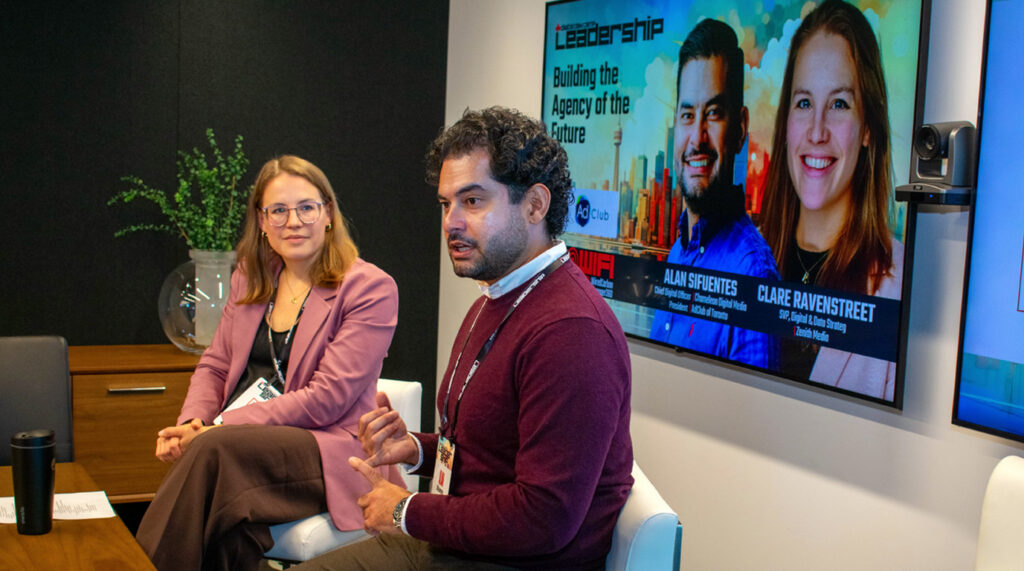
At Digital Day Camp (DDC) Leadership Fall 2026 in Toronto, Clare Ravenstreet and I asked a full breakout room of agency, publisher, brand, and ad tech leaders 1 question: will your company have fewer employees in 5 years? Most said yes. Almost nobody was willing to give up on junior talent. That tension is the real story behind AI and junior agency roles. Here is what came out of the session, and what agency leaders can do next.
The training ground for junior agency roles is shrinking
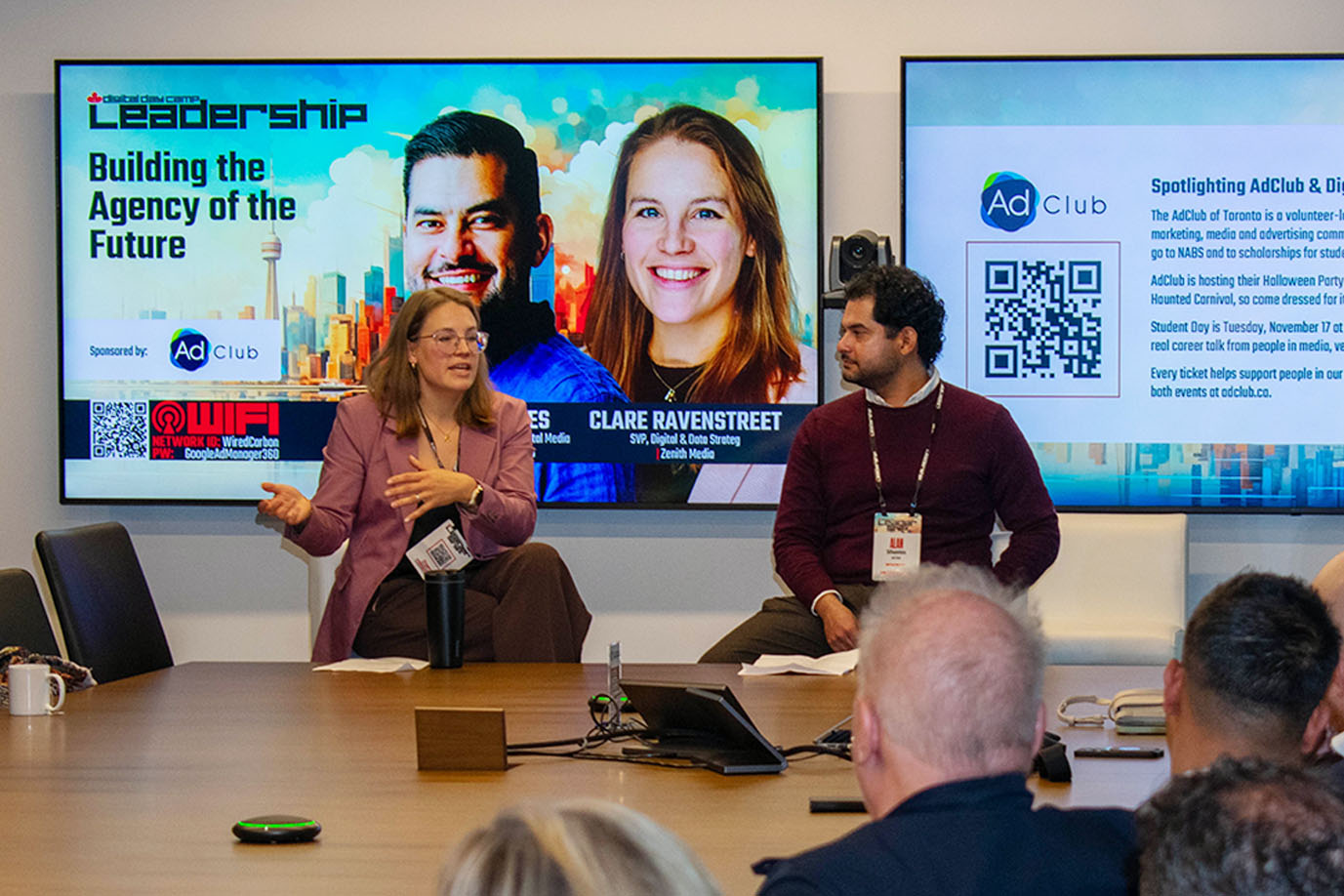
Clare, SVP Digital and Data Strategy at Zenith Media, and I co-led the session “Building the Agency of the Future.” Our premise was simple. Automation now handles much of the work that used to teach juniors the business. So where does the next generation learn the fundamentals?
The opening poll did not produce a clean number, and it did not need to. The direction was clear, and so was the follow-up. Everyone in the room agreed the pipeline of future directors and VPs still has to be protected.
The numbers point 1 way. In 1 survey, 57% of agencies said they had slowed or paused entry-level hiring as AI took on junior tasks.1 Workers aged 20 to 24 made up just 6.5% of US advertising, PR, and related services jobs last year, down from 10.5% in 2019.2
Canada adds its own pressure. Youth unemployment in Canada climbed from 10% in 2022 to 13.8% in 2025.3 It eased to 12.6% by July 2026, still above pre-pandemic levels.4 Toronto’s youth employment rate averaged 45.7% from 2023 to 2025, down from 48.0% from 2011 to 2019, the lowest of any Canadian city tracked.5 This is not a US headline. It is happening here.
The evidence on cause is mixed, and we said so in the room. A 4As and DBC paper found that AI may not be eliminating agency jobs yet.6 In the US, Ramp data found the companies spending the most on AI are hiring more, not cutting staff.7 Some of the slowdown traces back to the economy, not the machines. The fair read is this: whatever the reason, the training ground is shrinking.
Same tools, same data, different talent
Adoption is no longer the question. 93% of Canadian business leaders say their organizations use AI in some form, up from 61% a year earlier. Only 2% say they are seeing a return on their generative AI investments.8
That gap matters for agencies. If every shop runs the same models on the same data, plans start to look the same. What is left to compete on is price, or talent. As I said in the room: “Tech becomes the same for everyone. Talent doesn’t.”
That is where we put our energy at Chameleon Digital Media. We invest in our people and train our teams to build strategy, not just feed inputs into a tool. Every client comes to us with a different business problem, so every plan starts with that problem, not a template. A prompt can give you a media plan. It can’t give you one built around your business by people who know it.
How to hire for junior agency roles when AI does the execution
The first pillar was hiring, and the job itself is shifting. Entry-level jobs in AI-exposed fields are 7× more likely than less exposed roles to require skills usually tied to later career stages.9 Junior roles now ask for senior judgment. Yet in research published by the IPA, the UK advertising industry body, only 6% of agencies said they recruit for specific AI expertise at the point of hire.10 Agencies are already betting that tools can be taught.
The room’s answer was to hire for the traits that are hardest to teach:
- Curiosity, judgment, and communication over certifications. Tools can be taught.
- Critical thinking over polished answers to take-home tests and pre-interview questions.
- Soft skills screened harder than before, with in-person interviews where possible. Several leaders in the room said meeting candidates face to face added real value back to the process.
The goal is to redesign the junior role around strategic thinking instead of pressing buttons. “Don’t cut the junior role. Rebuild it around judgment instead of execution.”
Training juniors when the busywork is gone
Juniors used to learn by doing the repetitive work. When AI does that work, training has to be built on purpose. Clare and I walked the room through 4 learning modes:
- Doing: fake briefs, hackathons, and pro bono media plans
- Reviewing: critiquing AI outputs, spotting errors, and running team review sessions
- Observing: shadowing client calls and negotiations, or watching recorded calls for remote teams
- Simulating: internal competitions modeled on Junior Lions
None of these need a big budget. Most reuse work the agency is already doing, with a junior watching it, reviewing it, or trying it first.
Mentorship matters more now, not less. That changes how leaders should see a junior sitting in on a client meeting. “That extra person in the client meeting isn’t wasted billing. It’s the cheapest training you’ll ever buy.”
The time AI frees up for leaders should go back into people. We recommended shorter, more frequent 1:1s in place of the occasional long review. That investment pays back in retention. 78% of young people say they would stay longer with an employer that invests in their development, according to the 2026 Business Barometer cited by the IPA.11
Measuring junior agency roles on judgment, not tasks
If juniors are no longer measured by output volume, something has to replace it. The third pillar answered that directly:
- Count the good questions juniors ask, the patterns they spot, and the solutions they suggest or put in place, not just the tasks they finish.
- Ask juniors for short monthly notes on what they are noticing in campaigns and categories.
- Build both lenses: the short-term campaign view and the long-term brand view.
- Run frequent all-hands sessions where every level of the organization brainstorms ideas and works through problems together.
The reason is simple. “Automation without trained humans checking it is just a rubber stamp.”
What agency leaders debated in the room
The strongest material came from the audience, not the stage. 3 threads ran hot:
- Generalists vs. specialists. Will agencies need more generalists or more specialists as AI takes over execution? The room did not settle it, and it deserves its own session.
- Boutiques vs. holding companies. AI is giving boutique agencies an edge to compete. Large holding companies still have deal consolidation and access to more advanced technology on their side.
- Talent as the deciding factor. Human talent came up again and again as a key driver of agency success and client satisfaction.
Fewer people, maybe. But someone still has to become the next VP. The people approving the machine’s work in 5 years are the juniors agencies hire, or don’t, today.
If your agency is working through the same questions, talk to the Chameleon Digital Media team. We are always up for comparing notes on how to build the next generation of talent.
Alan Sifuentes is Chief Digital Officer at Chameleon Digital Media and President of Ad Club Toronto.
Related reading: DOOH Attribution: What Happens After the Impression (Full DPAA Webinar)
References
- Studio Sunup via 4As. “How Agencies Are Reshaping Junior-Level Roles and Training in the AI Era.” April 2026. https://www.aaaa.org/blog/how-agencies-are-reshaping-junior-level-roles-and-training-in-the-ai-era. Accessed October 2026.
- US Census Bureau and Bureau of Labor Statistics data via Adweek and eMarketer. “AI adoption cuts agency hiring and reshapes creative pipelines.” https://www.emarketer.com/content/ai-adoption-cuts-agency-hiring-reshapes-creative-pipelines. Accessed October 2026.
- C.D. Howe Institute. “A Difficult Start: Youth Unemployment and the Cost of Doing Nothing.” June 2026. https://cdhowe.org/publication/a-difficult-start-youth-unemployment-and-the-cost-of-doing-nothing/. Accessed October 2026.
- Business Data Lab, Canadian Chamber of Commerce. “Summer Sun Keeps Rising Over Canada’s Labour Market as July Hiring Surges: Labour Force Survey July 2026.” August 2026. https://businessdatalab.ca/publications/summer-sun-keeps-rising-over-canadas-labour-market-as-july-hiring-surges-labour-force-survey-july-2026/. Accessed October 2026.
- Business Data Lab, Canadian Chamber of Commerce. “It’s Back to School! But What Will Students Do After School?” September 8, 2026. Full analysis: BDL_2026_Blog_YouthWorkforce_EN.pdf, page 6. https://businessdatalab.ca/publications/its-back-to-school-but-what-will-students-do-after-school/. PDF: https://businessdatalab.ca/wp-content/uploads/2026/08/BDL_2026_Blog_YouthWorkforce_EN.pdf. Accessed October 2026.
- 4As and DBC. “Redefining Entry-Level Agency Positions in the Age of AI.” June 2026. https://www.aaaa.org/resource/redefining-entry-level-agency-positions/. Accessed October 2026.
- Ramp via Big Technology. “Heavy AI Adoption Linked To More Hiring, Not Layoffs, New Data Shows.” June 2026. https://www.bigtechnology.com/p/heavy-ai-adoption-linked-to-more. Accessed October 2026.
- KPMG Canada. “Canadian businesses adopting AI but few are seeing ROI.” November 2025. https://kpmg.com/ca/en/media/2025/11/canadian-businesses-adopting-ai-but-few-are-seeing-roi.html. Accessed October 2026.
- PwC 2026 Global AI Jobs Barometer via Allwork.Space. “AI is turning entry-level jobs into senior-level work.” June 2026. https://allwork.space/2026/06/ai-is-turning-entry-level-jobs-into-senior-level-work/. Accessed October 2026.
- Spark AI research via IPA. “Supercharging young talent in the AI age.” IPA AI Magazine, September 2026. https://the-ipa.shorthandstories.com/ipa-ai-magazine-september-2026/future-of-the-industry/supercharging-young-talent-in-ai-age/. Accessed October 2026.
- 2026 Business Barometer via IPA. “Supercharging young talent in the AI age.” IPA AI Magazine, September 2026. https://the-ipa.shorthandstories.com/ipa-ai-magazine-september-2026/future-of-the-industry/supercharging-young-talent-in-ai-age/. Accessed October 2026.