


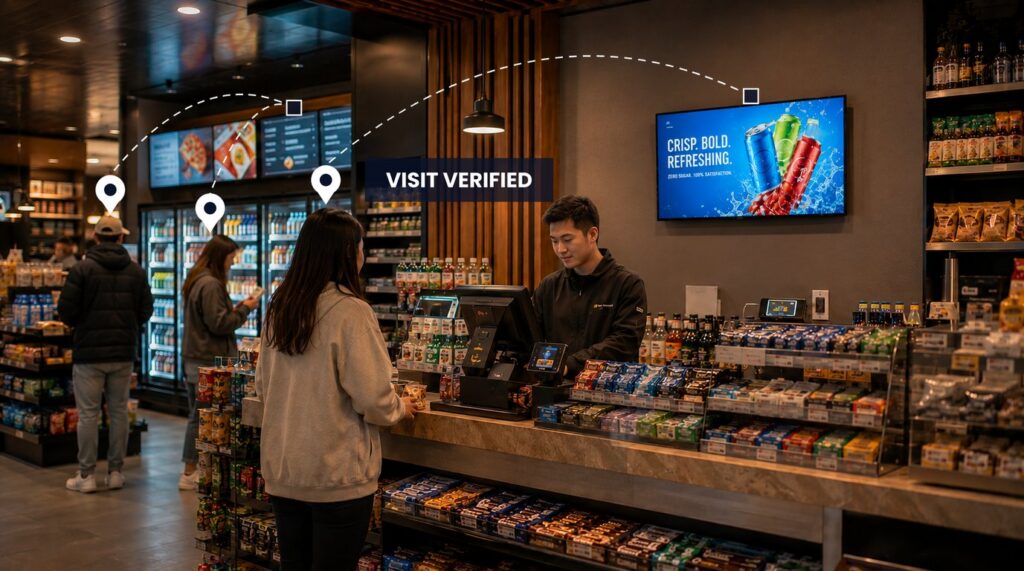
US out-of-home revenue hit a record $9.46B in 2025, and digital screens drove the growth.1 Yet most screen operators still sell the play, not the person. When a buyer asks who saw the ad and whether they walked into the store, the answer stops at the door. DOOH store visit attribution closes that gap, and the audience it reveals becomes something operators can sell.
DOOH store visit attribution is now part of the buy
Digital out-of-home grew 10.5% in 2025 and now makes up 36.3% of US out-of-home revenue.1 70% of the top 100 out-of-home advertisers increased their spend, and 16% more than doubled it.2
That money does not come from an out-of-home budget alone. Screens compete with every channel in the plan, and the other channels arrive at the renewal meeting with conversions. Search reports clicks. Social reports purchases. A play log reports delivery.
Consumers say the screens work. In a 2024 Harris Poll survey for the Out of Home Advertising Association of America, 76% of US respondents said a DOOH ad had recently prompted them to take action, and store visits ranked among the most frequent actions.3 That is self-reported. The buyer wants it observed, venue by venue, against people who never saw the ad.
How a screen exposure becomes a verified store visit
Chameleon Digital Media presented this method to DPAA members on October 8, 2026, in the DPAA Research, Retail and Technology Series. Alan Sifuentes, Chief Digital Officer, and Cheryl Luciani, VP Sales, walked through 4 steps:
- Capture. While the spot plays, we record the devices in front of the screen. The data comes from opted-in mobile apps, aggregated into cohorts, with no personally identifiable information.
- Verify. A visit counts only inside a hand-drawn polygon around the store, with precision of about 3 feet, and only when the device stays long enough to be a customer. Dwell patterns filter out staff and people passing by.
- Look back. Up to 12 months of movement history, so a baseline can be set after the campaign starts, including last year or the 4 weeks before the flight.
- Activate. The verified audience goes live on mobile, CTV, social, and the other channels the advertiser buys.
Radius circles count the parking lot, the coffee shop next door, and the bus stop. A polygon drawn around the door counts the people who walked in. That is the practical difference between verified and modeled data: Chameleon Digital Media builds the audience from devices observed at the venue, not from segments inferred from browsing interests.
The data behind it is large enough to read individual venues. Chameleon Digital Media observes 32M+ Canadian devices monthly, and the same method runs across 154M addressable people in the US.4 How we collect and protect that data is set out on our compliance page.
Measure store visit lift, not only the play
Chameleon Digital Media measures 3 links in the chain:
- Exposure: the impression, logged against a device, on your screen or on any other channel.
- Visit: the device enters the store polygon and stays.
- Outcome: lift, measured against a matched control group or a pre-campaign baseline.
4 numbers come out of it: visit rate, incremental visits above the control, lift by venue, and campaign lift. Your advertisers may call these footfall, store lift, or brand lift. It is the same chain.
A single pixel on the digital creative extends this across the plan. It tags impressions on your screens, on mobile, and on CTV, including media bought outside Chameleon Digital Media, and reports store visits and online conversions together in Datalytica. Your screens stop being the line nobody can attribute and become the first touch in a chain the buyer can see. We covered the reporting side in more detail in closed-loop attribution with Datalytica.
There is 1 honest limit. Proof is easiest when the advertiser owns a door people can walk through: electronics and phone stores, grocery, drug stores, quick service restaurants, malls, and event venues. A soft drink ad cannot prove a store visit. An ad for a product you can try today at a named store can.
What the campaigns showed
A direct-to-consumer apparel brand in Toronto asked the question every operator hears: do the screens drive people into the store, and which placements do it best?
Measured on an operator’s out-of-home screens, the campaign drove a 160% lift in total store visits and 4× the visits at the brand’s flagship store.5 Unique responders rose 80%, and 51% of visitors came from households earning $100K+.5
The same chain has worked in other categories presented in the webinar. A convenience retail campaign drove a 54% lift in store traffic. A lottery campaign that paired in-store DOOH with mobile retargeting returned 7.2× its ad spend.5
The apparel result changed the conversation for the operator. Out-of-home did not only increase visits. It moved traffic toward the flagship and told the brand who its out-of-home audience really was. The operator walked into the next planning cycle with numbers a buyer could put in a deck. More examples are on our case studies page, and the audience precision case study shows the same method applied to targeting.
Turn your screen audience into a revenue line
Every time your screens play, an audience is created. Today you log the play and send a report after the fact. With verified visits, you can sell the people.
That starts with segments built from where devices were actually seen, for example:
- Commuter coffee buyers: seen at gas stations, transit hubs, and quick service restaurants, 6 to 9 AM on weekdays.
- Family meal drivers: seen at grocery, big box, and schools, 4 to 7 PM and on weekends.
- Late night snackers: seen at quick service and convenience after 8 PM, skewing 18 to 34.
Then the advertiser does 3 things with the audience your screen created:
- Retarget the people who saw the ad and did not come in.
- Exclude the people who already bought, so the budget stops paying to reach them twice.
- Extend with lookalike and household audiences built from a verified seed.
Operators can work with Chameleon Digital Media in 3 ways, and white label sits across all of them:
- Managed service: we run the audience, the media, and the reporting, and you sell it.
- Audience push: we deliver the segments into your preferred DSP, Meta, or TikTok, and you keep your seat.
- Measurement only: run your media anywhere, and we measure it independently.
Your direct clients buy screens from you today. Through our digital media services, you can add CTV, social, and mobile to what you sell without building any of it.
Start with 1 screen
You do not need a network-wide rollout to see what your audience looks like. Send Chameleon Digital Media 1 high-traffic screen or location, and we will send back a free location analysis: who is in front of it, when they show up, and where they go next. Have an RFP or a renewal on the line? Send that too.
Watch the full DPAA webinar replay, then send us 1 venue or contact our sales team.
References
- invidis via OAAA. “OoH Revenue in the U.S. Hits Record $9.46B as Digital Screens Drive Growth.” https://invidis.com/sixteen-nine/2026/03/18/ooh-revenue-in-the-u-s-hits-record-9-46b-as-digital-screens-drive-growth/ Accessed November 2026.
- invidis via OAAA. “OoH: Apple Tops Ad Rankings as DooH Keeps Growing.” https://invidis.com/news/2026/04/ooh-apple-tops-ad-rankings-as-dooh-keeps-growing/ Accessed November 2026.
- OAAA and The Harris Poll. “New Study Finds Digital Out of Home Advertising Surpasses Other Media in Driving Favorability and Action Among Consumers.” April 30 2024, 1,023 US adults 18 to 64. https://oaaa.org/news/new-study-finds-digital-out-of-home-advertising-surpasses-other-media-in-driving-favorability-and-action Accessed November 2026.
- Chameleon Digital Media location data. “Canadian devices observed monthly.” https://chameleondigitalmedia.com/digital-media-analytics/ Accessed November 2026.
- Chameleon Digital Media. “Direct-to-consumer apparel brand, Toronto, measured on out-of-home screens.” Source file: RMG-Case-Study.pptx (as cited in DPAA_PresenterGuide_05OCT2026_v5.docx). https://chameleondigitalmedia.com/case-studies/ Accessed November 2026.